Tariffs Are Bringing Down the Trade Deficit While Allowing the AI Boom to Continue
America’s trade deficit narrowed unexpectedly in September, and the gap through the first nine months of the year was 12.2 percent smaller than a year earlier. President Donald Trump’s trade policies appear to be doing exactly what critics said they could not: shrinking the trade deficit.
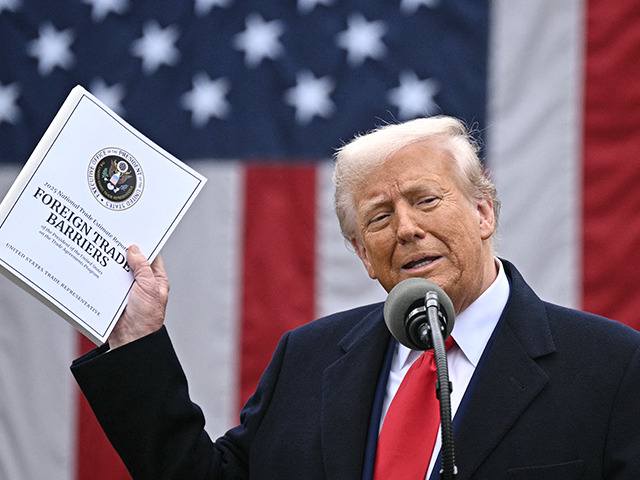
President Donald Trump delivers remarks on reciprocal tariffs during his “Liberation Day” event in the Rose Garden at the White House on April 2, 2025. (Brendan Smialowski/AFP via Getty Images)
The Commerce Department reported Wednesday that the deficit fell 0.7 percent to $105 billion, below the $108 billion economists expected. Exports increased 1.9 percent, outpacing a 1.2 percent rise in imports. Through September, the deficit was $92.4 billion smaller than during the same period last year.
That improvement came despite another enormous increase in purchases of equipment for America’s artificial intelligence buildout. Computer imports jumped $7.6 billion in September, while computer accessories rose $5.7 billion. Capital-goods imports overall increased $11.6 billion.
Those purchases explain why the headline deficit conceals a much bigger improvement elsewhere.
Look Beneath the Headline
On Wednesday, Harvard economist Jason Furman posted charts on X that make the distinction unusually clear.
The latest trade data takes us through September. It shows that the overall trade deficit amounted to around 2.7 percent of gross domestic product. That compares with 2.9 percent in 2024 and 3.3 percent in 2025. Once we exclude data-center goods, however, this year’s deficit shrinks to just 0.7 percent of GDP. In the same period in 2024, it was 2.2 percent. Last year, it was 2.3 percent between January and September.
In other words, excluding the AI boom, the trade deficit is contracting rapidly as a share of the U.S. economy.
The goods-only comparison tells an even better story. Excluding data-center equipment, the goods deficit has fallen to 1.8 percent of GDP from 3.3 percent in 2024.

In short, the underlying numbers say the tariffs are working.
What obscures the progress is the extraordinary demand for computers, computer accessories, semiconductors, and telecommunications equipment. Furman’s charts group these four categories as data-center goods. Their combined deficit has expanded to approximately 2.1 percent of GDP, roughly triple its 2024 share.
Critics pointing to the headline deficit as proof of failure are overlooking the transformation taking place inside it. What’s more, the headline deficit would likely be even larger if we had all this AI investment without import tariffs to encourage domestic production.
The Investment Collapse That Wasn’t
The imports masking the improvement in the trade balance also tell us something important about the predictions that Trump’s trade policies would choke off investment and damage economic growth.
American businesses are buying extraordinary quantities of equipment to expand productive capacity. And the administration’s tariff exemptions help explain why. Preserving access to the equipment needed for that expansion is part of the policy itself.
Instead of a collapse of investment, we are seeing that American businesses are buying extraordinary quantities of equipment to expand productive capacity. The AI investment boom is large enough to obscure a sharp narrowing of the deficit elsewhere.
A Trade Policy That Makes Distinctions
One of the reasons that data center imports have been able to rise so sharply is that key categories of equipment supplying the AI boom are exempt from Trump’s reciprocal tariffs. Computers, computer parts, semiconductors, and specified networking equipment benefit from exclusions. The administration’s separate tariff on certain advanced chips also makes an explicit exception for qualifying American data centers.
That helps explain why these imports are booming. It also demonstrates that the Trump administration’s tariff policy makes prudent distinctions. The administration is applying pressure to change trade patterns while preserving access to equipment American businesses need to expand.
Critics have lambasted Trump’s tariffs as indiscriminate and thoughtlessly applied. But this can only be maintained by steadfastly ignoring the exemptions that are part of the policy. They allow the AI buildout to proceed while America works to restore the manufacturing capacity needed to supply more of it domestically.
The resulting picture is precisely what the headline deficit obscures: a sharp improvement in trade outside data-center goods, alongside an enormous investment boom supplied in part by imports the administration has chosen to accommodate.
Rebuilding Will Take Time
As we’ve pointed out before, the investment boom has exposed the economic dependence created by decades of offshoring. America is building the infrastructure, but much of the equipment must be purchased from foreign factories because that is where manufacturing capacity was allowed—and even encouraged—to flow during our long era of globalization.
Rebuilding our high tech manufacturing capacity will take time. For now, the trade figures show an economy investing aggressively while its deficit outside data-center goods contracts sharply. The headline number hides the scale of that improvement. Furman’s charts bring it into view.