Factory Demand for U.S. Labor Is Rising Sharply
The dominant narrative about the labor market is that it is stuck in a “low hire, low fire stasis.“ Relatively few workers are being put on payrolls, and few are being knocked off.
The low hire portion of the analysis is typically interpreted as demonstrating a hesitancy on the part of employers, perhaps due to uncertainty about economic policy, interest rates, and geopolitics. It is often read as a sign that demand for labor has plateaued.
That’s an illusion. Demand for labor is rising across the American economy, with an especially sharp increase in manufacturing. To see this, however, it helps to look beyond figures like monthly payroll numbers or even job openings and include the number of hours worked.
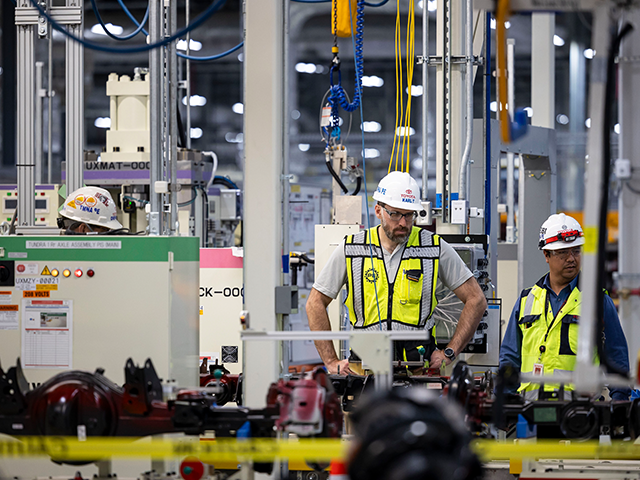
Workers stand by the assembly line at the new rear axle plant at Toyota Texas in San Antonio, Texas, on March 2, 2026. (Katina Zentz/San Antonio Express-News via Getty Images)
A factory that adds half an hour to its average workweek has increased its demand for labor even if its head count hasn’t budged. Multiply that across millions of workers and you have a substantial increase in the amount of labor businesses are purchasing. Employers can also seek additional workers without having hired them yet. An unfilled position represents demand for labor.
Combining all three of these—employment levels, vacancies, and the average workweek—produces what we call the Labor Demand Proxy.
The calculation is straightforward: add employment to job openings and multiply the total by average weekly hours. That gives us an estimate of the weekly labor hours businesses are using or seeking to fill.
The inputs come from the Bureau of Labor Statistics. We use monthly, seasonally adjusted figures for all employees, matching employment, openings, and hours within each sector. Our broad measure covers the private nonfarm economy. For unfilled jobs, we use the same average workweek as for existing employees.
A Factory Labor Demand Boom
What does it show?
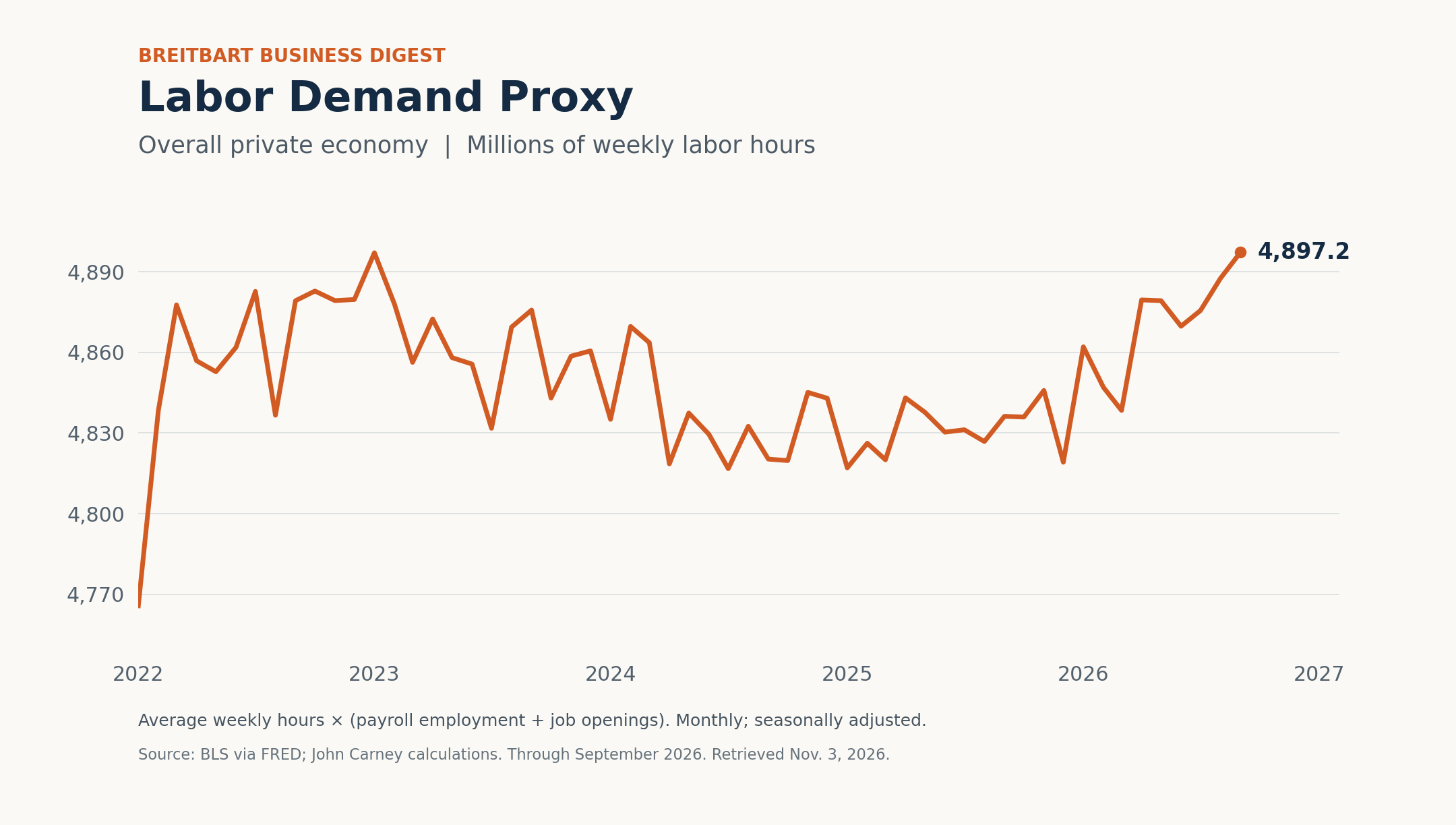
Across the private economy, the proxy rose 1.6 percent over the first nine months of the year. Over the same period, the U.S. labor force increased just 0.11 percent after removing the effect of January’s population-estimate adjustment. Demand for labor is growing much faster than the workforce available to meet it. If we annualized those three quarters, labor demand is growing at a 2.2 percent rate.
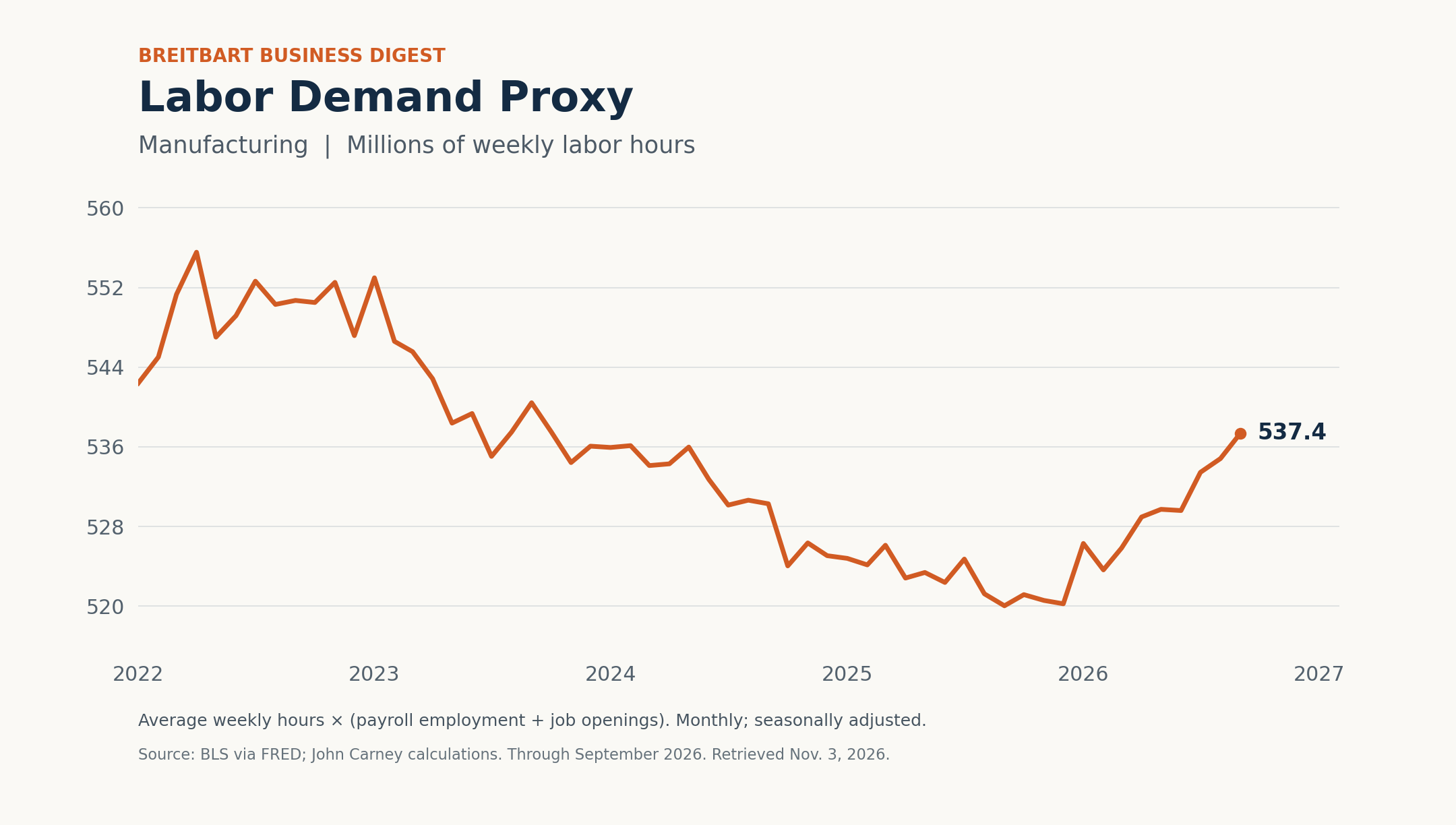
Manufacturing’s Labor Demand Proxy rose to 537.4 million weekly hours in September, from 520.2 million in December. That’s a 3.3 percent increase through the first nine months of the year. Annualized, that comes to 4.4 percent.
In durable goods manufacturing, the increase is 4.0 percent, bringing the measure to 340.3 million weekly hours. Compared with September of last year, durable goods labor demand is up 4.5 percent. That’s equivalent to an annualized pace of 5.3 percent.
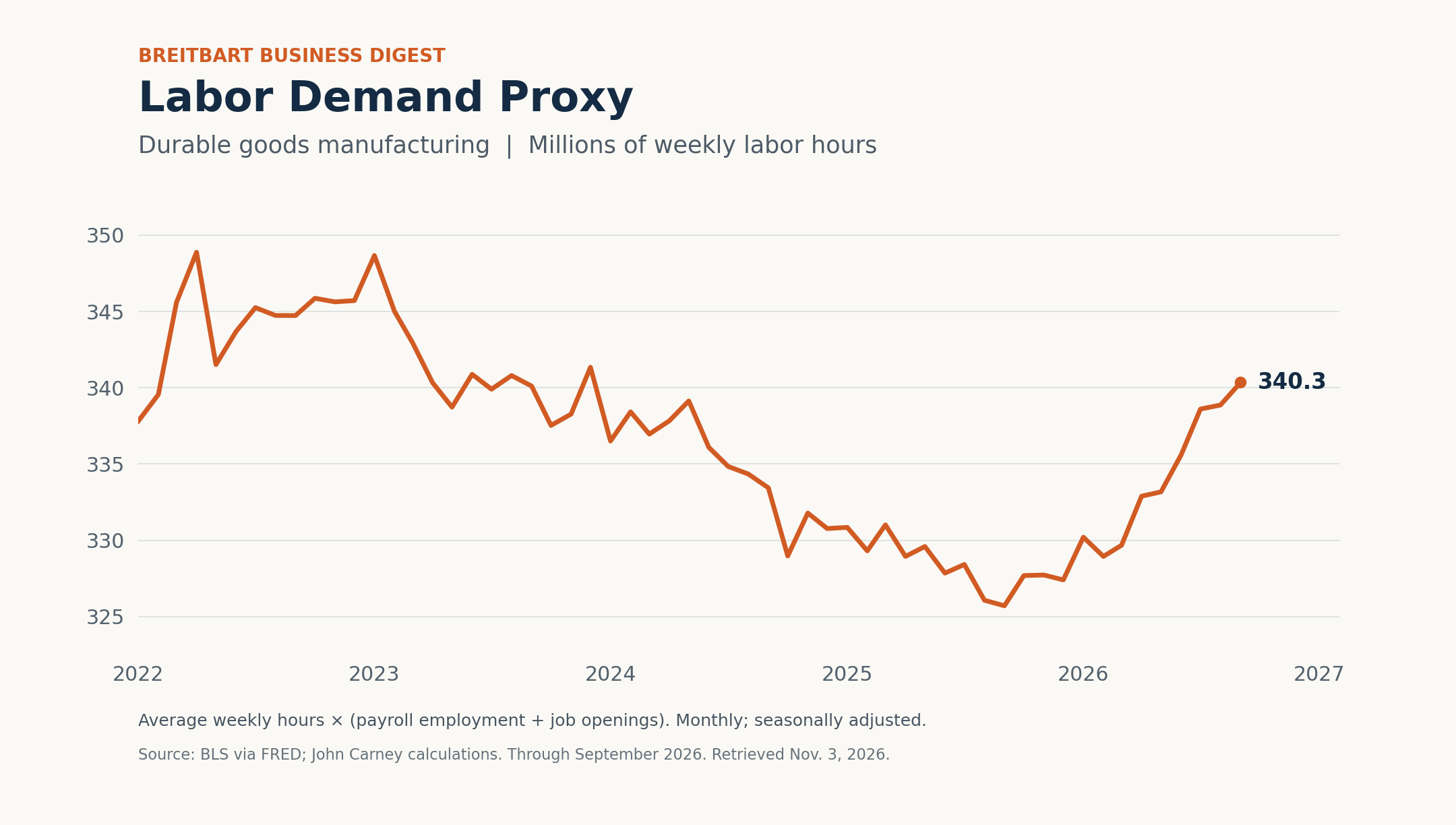
Notice that the charts show a striking turnaround under Trump. Manufacturing labor demand spent much of the end of the Biden era in decline. It bottomed last September, a few months after President Trump announced his tariff policy and signed the One Big Beautiful Bill’s tax cuts into law. Since then, despite a few monthly reversals, the direction has been up. Durable goods tells the same story.
This isn’t just a surge in “help wanted” signs. The average manufacturing workweek has lengthened to 40.6 hours from 40.0 in December. Factory employment is also higher. Businesses are using more labor and looking for more workers.
The trouble with the “low hire, low fire” story is how easily it becomes a claim that nothing much is happening. The Labor Demand Proxy shows that American businesses—especially American factories—have a growing demand for American labor.