The Fed's Secular Acelerationist Stance
Even while the American public remains in quite a sour mood about the American economy, the Federal Reserve has become increasingly bullish.
You can see it in officials’ projections for faster growth and lower unemployment. You can also see it in their expectation that this stronger economy will operate with substantially higher interest rates than they anticipated two years ago.
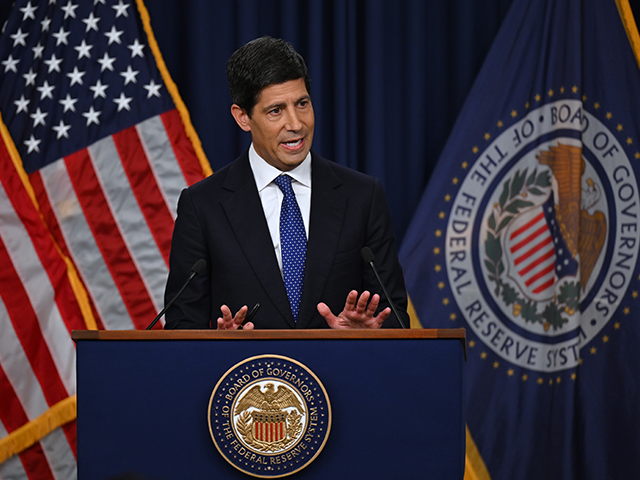
Federal Reserve Chair Kevin Warsh attends a press conference in Washington, DC, on September 16, 2026. (Li Rui/Xinhua via Getty Images)
That last part has lately been treated in the financial press as bad news. That’s not particularly unusual. Higher rates are routinely treated as evidence of trouble ahead for growth and jobs. Read the Fed’s projections together, however, and that’s not the message at all. Officials increasingly expect economic strength to coexist with higher rates while inflation eventually returns to two percent.
The Evolution of 2027’s Economy
Let’s focus on the projections for next year. This is useful because these have appeared in every quarterly Summary of Economic Projections (SEP) since September 2024. Back then, the median forecast called for two percent growth, unemployment of 4.2 percent, and a federal funds rate of roughly 2.9 percent. Inflation would be at two percent, and interest rates would have settled at their estimated longer-run level.
The latest projections put growth in 2027 at 2.4 percent, unemployment at 4.1 percent, and the funds rate at 4.1 percent. The underlying median rate projection has increased by 125 basis points. Officials have substantially raised the interest rate they expect to accompany an economy growing faster and sustaining lower unemployment.
The change is even more pronounced compared with the pessimism of June 2025. Officials then expected 2027 growth of just 1.8 percent, unemployment of 4.4 percent, and a funds rate of 3.4 percent. Since then, they have raised growth by six-tenths of a percentage point and lowered unemployment by three-tenths while revising rates upward. The anticipated economy has strengthened considerably.
This is a major change in the economic outlook. For years, the dominant view was some form of the secular stagnation thesis which held that chronically weak demand and insufficient investment opportunities would leave advanced economies dependent on very low interest rates. The Fed’s evolving outlook invites a different description: secular acceleration. A more productive economy, offering better investment opportunities and stronger returns, can sustain faster growth alongside higher interest rates.
In that setting, higher interest rates should be seen as reflecting greater competition for capital from businesses that see profitable uses for it. Firms are willing to pay more to finance expansion because the expected returns justify it. That is a recognizable expression of economic strength.
The Future Gets Brighter Too
We can also see evidence of that reassessment in the longer-run projections. Since September 2024, officials have raised estimated sustainable growth from 1.8 to two percent and the longer-run funds rate from 2.9 to 3.2 percent. Their inflation forecast remains two percent—in part because the Fed’s longer-run forecast for inflation always has it returning to target. If this were to move, it would indicate that Fed officials no longer see inflation returning to target or had quietly raised the target. The higher rate therefore implies a higher estimated real neutral rate, consistent with an economy in which investment demand is stronger.
The employment outlook is particularly revealing. Unemployment is projected to remain at 4.1 percent every year from 2026 through 2029, below the unchanged longer-run estimate of 4.2 percent. Growth remains above its longer-run estimate throughout. Meanwhile, headline inflation falls from 3.7 percent this year to 2.3 percent in 2027, 2.1 percent in 2028, and two percent in 2029. Officials foresee disinflation without a deterioration in employment or growth. The classic tradeoff of accepting higher unemployment and lower growth to bring down inflation seems to have been brushed aside. The projections now show a kind of immaculate disinflation alongside secular acceleration.
Slower workforce growth makes the growth upgrades more striking. Not that long ago, many economists and pundits were arguing that Trump’s crackdown on illegal immigration would slow economic growth. There’s no sign of that in the SEP. Quite the opposite. The economy continues to grow faster than the longer-run trend for as far as the eye—or at least the SEP—can see.
The inflation forecast indicates that officials expect they will be patient. Two years ago, the SEP suggested that officials expected to reach two percent in 2026. The latest projections show inflation is not expected to return to target until 2029. If officials thought a more aggressive policy were warranted to bring inflation down faster, we’d see even higher projections for the fed funds rate and likely a slower path for growth and higher unemployment.
The economic configuration officials now envision is unmistakably more bullish: faster growth, persistently low unemployment, and higher interest rates consistent with eventual price stability. In short, the Fed is gradually revising upward its assessment of what the American economy can do.