Chasing Kevin Warsh's Invisible Dot
Kevin Warsh gaveled to order his first Federal Open Market Committee meeting as Fed chairman on Tuesday. Tomorrow he’ll hold his first press conference. The most interesting thing about it may be what he doesn’t say.
Warsh has spent more than a decade arguing the Fed talks too much. His prescription, delivered to investors last year, ran to four words: “More thinking, less talking.” He thinks the central bank has buried itself in forward guidance, dot plots, and a daily chorus of officials freelancing on every side of every question. He wants the Fed back on page B12 of the business section.
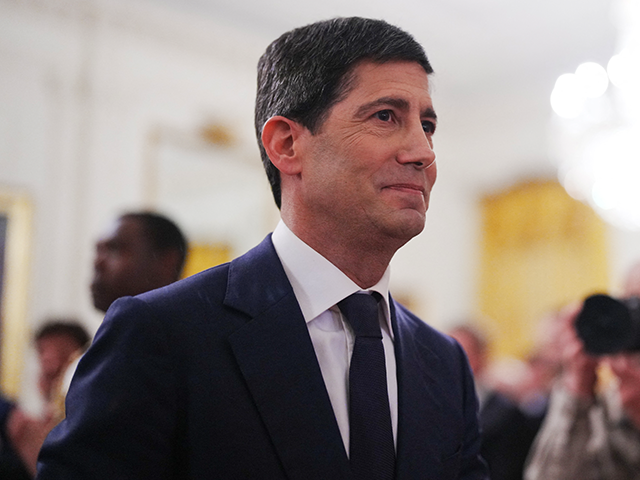
The new Chairman of the Federal Reserve Kevin Warsh departs the East Room of the White House after a swearing in ceremony in Washington, DC, on May 22, 2026. (Aaron Schwartz/AFP via Getty Images)
On rates, Wednesday will oblige him. With inflation still elevated from the Iran energy shock, nobody expects a move—the funds rate stays at 3.5 to 3.75 percent, and the conversation around the table has drifted toward hikes, not cuts, later this year. The CME’s Fed Watch tool, which calculates the odds of Fed policy moves implied by prices of federal funds futures contracts, now favors a single hike by year’s end, with an off-chance of two hikes and a 40 percent chance of no hikes. The
The statement will likely shed its “easing bias,” the language hinting the next move is down. Warsh inherits a committee that has stopped wanting to cut, and three dissenters at the last meeting said they wanted the language gone. If anything, that view has likely won adherents. Warsh himself dislikes including this sort of thing in the statements anyway. But that means it would be wrong to see pulling the language as strictly hawkish. Instead, it should be understood as the hawks and the anti-guidance reformers arriving at the same view.
Plots with Dots and Dots with Plots
So the action moves to the dots—the Summary of Economic Projections, where all 19 officials mark where they think rates are headed. BofA expects the median 2026 dot to show no cuts this year, a hawkish shift from March, with a few officials penciling in outright hikes. Inflation forecasts get marked up hard, growth marked down. The dots are about to deliver a genuinely hawkish message.
Except, perhaps, for one. We expect that Warsh won’t submit a dot at all. It’s his first meeting, and declining to forecast is the cleanest way to undermine a process he’s called “abysmal” without picking a fight by abolishing it. “My dots wouldn’t be perfect either,” he said last year, “so I wouldn’t give them.” He also has the excuse that perhaps he shouldn’t be making projections based on less than a month back at the Fed.
Of course, the absence of evidence of a Warsh projection will probably not be accepted as evidence of the absence of a private forecast. So that will set Fed watchers on the hunt to find Warsh’s invisible dot. With no marker on the chart, every analyst on Wall Street will try to reverse-engineer where the chairman stands from whatever he says. The big question is whether a theoretical Warsh dot would be below today’s fed funds rate, level with it, or possibly above.
Reporters in the room will likely be skeptical of the idea that Warsh doesn’t have a view about where rates are going next. But Warsh’s longstanding position is that the chairman shouldn’t have such a view. He’s not hiding an invisible dot. He just does not have a dot to plot or a plot on which to place the dot. That, however, will feel very unsatisfactory to journalists and analysts.
Another problem with trying to interpret this meeting’s Summary of Economic Projections is that rapidly moving developments with respect to the war with Iran might make them outdated the moment they drop. Gasoline has been a major force pushing up the official inflation gauges for three months. But this month it is likely playing the opposite role, pulling down the headline price index.
Run the back-of-envelope math. Gasoline averaged about $4.48 a gallon in May and added roughly a quarter-point to headline CPI. Now a gallon of gas is near $4.05 and falling, with Brent down around $78 as the Strait of Hormuz reopens. That same gasoline line is about to flip from an inflationary tailwind into a drag of similar size—a swing of better than a third of a point in the monthly headline. If we assume the rest of the basket behaves like it did in May, June CPI—which will be reported in July—comes in flat to negative if gasoline heads toward $3.90. And if gas keeps falling, July’s print becomes the stronger candidate for an outright negative headline.
And that’s the bind for the hawks. They built their case on refusing to look through the oil spike on the way up. Intellectual consistency says you don’t look through it on the way down either. The committee members who wouldn’t look through the shock are about to be handed a benign print they haven’t positioned for.
This rapid phase shift for inflation may actually be an early vindication of Warsh’s stance against forward guidance. In a world where inflation can jump from impressively hot in May to negative in July, staying nimble is more important than providing markets with faux-certainty.